
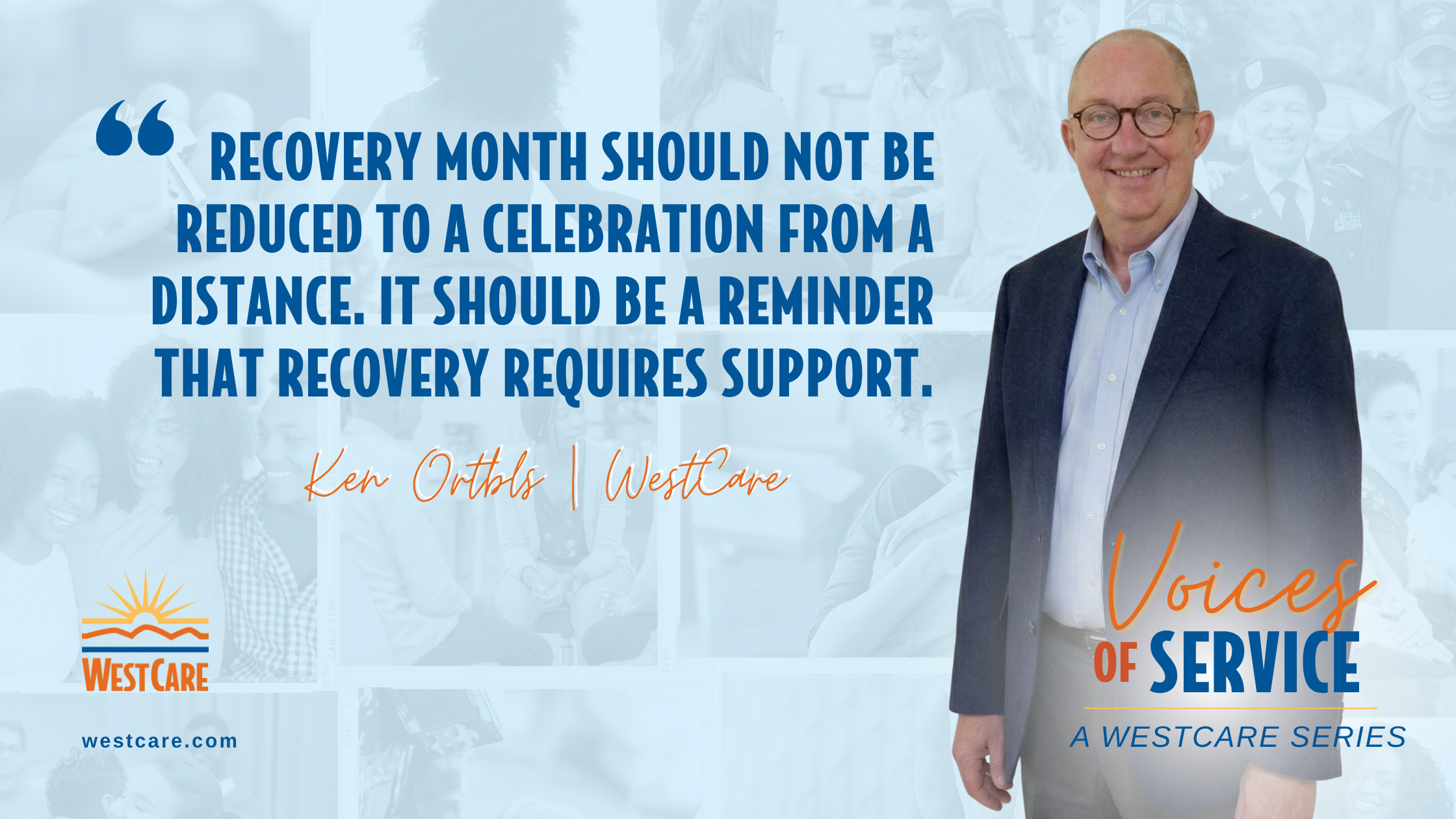
By Ken Ortbals, Chief Executive Officer
When I think about Recovery Month, I think first about people who keep showing up.
I think about the person in recovery who gets up and tries again after a hard day. I think about the parent who keeps a counseling appointment even when life is complicated. I think about the Veteran who begins talking about pain that has been carried for years. I think about staff members who answer phones, manage crises, complete documentation, sit with families, prepare meals, run groups, maintain buildings, and help people believe that tomorrow can be different.
Recovery is often described as a journey, and that is true. But journeys are made of ordinary, difficult steps. Keeping an appointment. Taking medication. Calling a sponsor. Accepting housing support. Going to work. Rebuilding trust. Apologizing. Trying again. Letting someone help.
Across WestCare, our teams serve people with substance use disorders, mental health needs, housing instability, justice involvement, trauma, and family challenges. The work is meaningful, but it is not easy. Staff often meet people in the hardest season of their lives. They have to bring skill, patience, boundaries, compassion, and hope into situations that can be unpredictable and painful.
That is why Recovery Month should not be reduced to a celebration from a distance. It should be a reminder that recovery requires support. It requires treatment that is accessible. It requires housing, transportation, peer connection, family support, clinical care, employment pathways, and community partners who do not disappear when progress is slow.
It should also be a reminder to care for the caregivers. The people doing this work need training, supervision, tools, safe workplaces, and encouragement. A strong recovery system depends on a strong workforce. When staff are supported, the people we serve feel it.
I have seen recovery in big public moments, such as graduations and reunifications. I have also seen it in quieter ways: a calmer voice, a safer choice, a family conversation that ends differently than it used to, a person who begins to imagine a future again.
Recovery Month belongs to the people living those moments. It belongs to the families who love them. It belongs to the staff and partners who keep opening doors. And it belongs to every community willing to say that recovery is not only possible, it is worth investing in.
![Read more about the article National Coloring Day Coloring Pages [DOWNLOAD]](https://westcare.com/wp-content/uploads/2023/11/pexels-mentatdgt-1078744-300x200.jpg)